



The leading specialist in adjustable gas springs
An adjustable gas spring offers the flexibility to easily tailor the force to the specific application. Instead of choosing a gas spring with a fixed pressure, you can adjust the internal nitrogen level using a valve during installation – allowing you to achieve exactly the right level of support.
Contact us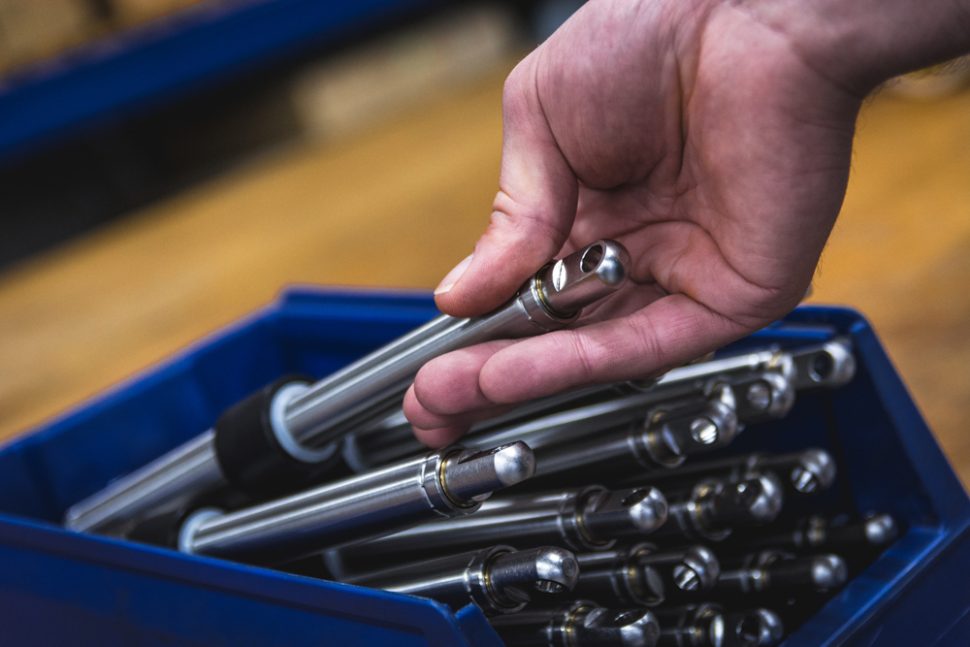
REPLACE YOUR GAS SPRING
Replace and order your current T-Technics gas spring easily & quickly with the article number. Order your gas springCALCULATE YOUR GAS SPRING
Order your desired gas spring in just a few steps using our configurator. Assemble a panel/hatch gas springCATALOGUE
The gas springs are custom-made for each customer and offer virtually unlimited possibilities. View catalogue
How an adjustable gas spring works
This gas spring consists of a cylinder containing compressed gas (usually nitrogen) and a piston rod. Via a valve – often accessible with an Allen key – you can release gas during or after installation, thereby reducing the pressure until the correct level is reached. Top-quality gas springs are supplied at maximum force as standard, so that you can then reduce the force until the correct balance is achieved.

Advantages in prototypes and variable applications
As the force can be adjusted after installation, adjustable gas springs are ideal for:
- Development phases where the exact load is not yet known at the design stage
- Applications with varying weights, such as machines or valves to which additional loads are regularly applied
- Safety-critical systems, where excessive or insufficient pressure must be corrected quickly
With a single set of gas springs, you can test different scenarios without having to order a new spring each time.

What you need to know for correct adjustment
When fitting, start with the gas spring fully extended, as recommended by most suppliers. Gently reduce the gas spring tension in small increments (for example, using an Allen key) until the unit or hatch remains exactly in the desired position. Please note: adjusting the gas spring is a one-way process; once you have removed too much gas, you cannot restore the force. It is therefore advisable to always start with slightly more force than is necessary.