



How does a gas spring work?
Step into the world of the gas spring and discover how a seemingly simple component still plays an important role in movement and support.
Contact us
REPLACE YOUR GAS SPRING
Replace and order your current T-Technics gas spring easily & quickly with the article number. Order your gas springCALCULATE YOUR GAS SPRING
Order your desired gas spring in just a few steps using our configurator. Assemble a panel/hatch gas springCATALOGUE
The gas springs are custom-made for each customer and offer virtually unlimited possibilities. View catalogue
What is a gas spring?
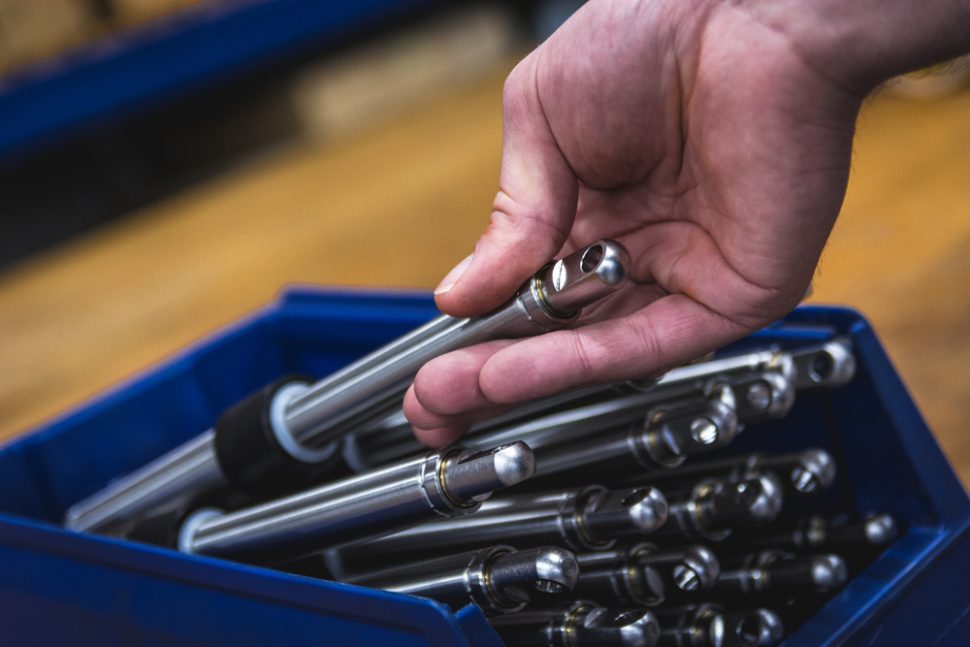
A gas spring is essentially a cylinder in which a gas is stored under pressure — typically the gas used is nitrogen. This gas-filled cylinder is then combined with a piston rod that slides freely in and out. The force comes from the expansion pressure of the gas — this is, for example, a difference from the operation of a traditional coil spring, where the force originates from elastic deformation.
How does a gas spring work?
The moment the piston rod is pushed into the cylinder, the available volume for the gas decreases. As a result, the pressure inside the cylinder increases and a counterforce builds up, which causes the rod to extend again as soon as the external load diminishes. At the same time, the style of mounting, the dimensions of the cylinder and the rod lead to what is known as progression — in other words, the force changes throughout the stroke. The fluid, usually oil, in certain gas springs provides damping within the gas spring, so that the movement proceeds in a controlled manner.

What factors play a role in how it works?
A number of factors within the gas spring determine how the gas spring behaves. The internal gas pressure determines the force the spring can deliver — the higher the pressure, the greater the force. In addition, the diameter of the piston influences the force of the gas spring — a larger surface area means more force. Temperature also plays a role in the operation of a gas spring: at lower temperatures, effectiveness may decrease. The mounting of the gas spring is also important — the piston rod of the gas spring should preferably point downward, so that the seals remain properly lubricated and the lifespan is extended.
Why is it important to understand how a gas spring works?
If you understand how a gas spring is constructed and functions, you can better assess whether a chosen gas spring is suitable for your application. It prevents springs that are too weak or too strong, guarantees safer operation and contributes to a longer lifespan of the spring installation. Moreover, you can recognise signs of wear earlier — for example, when the flap that the spring supports becomes increasingly difficult to open or falls down more quickly, there is reduced support, often as a result of gas pressure loss or leakage.

Buy a gas spring from T‑Technics?
Would you like to purchase a gas spring that suits your application and that has been correctly designed based on its operation and specification? With us, you will find a range in which quality, correct force calculation and reliable operation take centre stage. Get in touch for advice or order your gas spring directly. We are also happy to explain which gas spring you need and how to mount it, so you can get started straight away.